At 25, you skip breakfast, crush a spin class, and somehow survive on iced coffee and hope. At 45, the same routine leaves you foggy, ravenous, and wondering if your metabolism died in its sleep.
Intermittent fasting is an eating pattern that cycles between set periods of eating and fasting, such as 16 hours of fasting and an 8-hour eating window. It changes when you eat rather than what you eat, and the best schedule depends on your age, your goals, and your health.
Below, you’ll find how it works, the most common schedules, what the research says about benefits and risks, and an intermittent fasting by age chart to help you fast smarter, not harder.
What is intermittent fasting?
Intermittent fasting (IF, for short) is a time-based eating schedule where you cycle between periods of fasting and eating. There are no rules about which foods to eat, only when to eat them. According to Johns Hopkins neuroscientist Mark Mattson, who has studied the practice for decades, the goal is to go long enough without food that your body burns through its sugar stores and starts burning fat.
You’ll see several types of fasting, the most common being 16:8 (16 hours of fasting, 8 hours of eating). But it can be 14:10, 12:12, or even alternate days, depending on your goals.
Think of it less like a diet and more like a “lifestyle,” as Ronan Diego, a holistic health mentor, puts it in his Beyond Fasting program on Mindvalley. One that works with your biology, improves insulin response, and activates cellular repair processes (a.k.a. autophagy, if you want to sound scientific at dinner parties).
People have done this for centuries: spiritually (like Muslims during Ramadan), culturally (like Indigenous communities before hunts, ceremonies, or rites of passage), and accidentally (when they forgot to grocery shop).
“If you are not eating right at this moment, that means you’re fasting,” Ronan adds. But the key, he points out, is the length of the fast. After a certain point, your body shifts gears and starts running on a different kind of metabolism.
And just to clear the air: IF isn’t about restriction or punishment. If you’re skipping meals out of guilt or fear, that’s not fasting.
Fast the smart way
Join this free masterclass and learn how intermittent fasting works.

How does intermittent fasting work?
Intermittent fasting works by triggering what researchers call metabolic switching. Once your body uses up the sugar stored in your liver, it starts breaking down fat into ketones for fuel. In humans, ketone levels begin to rise roughly 8 to 12 hours into a fast, according to a 2019 review in the New England Journal of Medicine by Rafael de Cabo and Mark Mattson.
As Ronan explains, when you fast long enough, you “empty the storage inside of your muscles and your liver and start pulling the energy from the fat cells.” Here’s what else goes on under the hood, based on research on the metabolic effects of intermittent fasting:
- Insulin levels drop. Insulin tells your body to store fat, so when it falls during a fast, your cells can burn what’s already there.
- Fat becomes fuel. Without carbs coming in, your body breaks fat down into ketones, which become your backup energy source.
- Autophagy kicks in. This is cellular cleanup, where old, damaged cell parts get recycled.
- Hormones rebalance. Fasting raises human growth hormone (HGH), improves insulin sensitivity, and may influence hunger hormones like ghrelin and leptin.
- Circadian rhythms realign. Eating within daylight hours helps sync your body clock, which can improve your sleep schedule, digestion, and metabolism.
Disclaimer: This information is for educational purposes only and is not intended as medical advice. Always consult a healthcare professional before starting any fasting protocol, especially if you have underlying conditions or take medications.
Intermittent fasting schedules: which one is best?
The best intermittent fasting schedule is the one you can stick to. Most beginners start with 12:12 or 14:10 and work up to 16:8, one of the most popular and widely studied daily schedules. Longer or full-day fasts aren’t automatically better, and Johns Hopkins notes that very long fasts can be risky without medical supervision.
Here’s how the most common intermittent fasting schedules compare, based on guidance from Cleveland Clinic and Mayo Clinic:
| Schedule | Fasting window | Eating window | Best for | Difficulty |
| 12:12 | 12 hours | 12 hours | Total beginners, older adults | Easy |
| 14:10 | 14 hours | 10 hours | Building the habit; many women | Easy |
| 16:8 | 16 hours | 8 hours | Most people once adapted | Moderate |
| 18:6 | 18 hours | 6 hours | Experienced fasters | Hard |
| 20:4 | 20 hours | 4 hours | Short-term use with guidance | Very hard |
| 5:2 | 2 non-consecutive days of about 500 to 600 calories | Normal eating 5 days | People who prefer weekly over daily rules | Moderate |
| Alternate-day | Every other day (no food or about 500 calories) | Normal eating on off days | Structured weight loss plans | Hard |
| Eat-stop-eat | 24 hours, once or twice a week | Normal eating other days | Experienced fasters only | Very hard |
Is it better to fast for 12 or 16 hours?
A 16-hour fast gives your body more time in fat-burning mode, since ketones only start rising after roughly 8 to 12 hours. A 12-hour fast is easier to sustain and still gives your digestion a long overnight break. Start with 12 hours, and move to 16 only if you feel good, sleep well, and keep your energy up.
Intermittent fasting by age chart
Not all bodies age the same way. Hormones get louder, sleep gets weirder, stress sticks around like glitter, and your metabolism starts taking longer coffee breaks. That’s why an intermittent fasting by age chart is more useful than a one-size-fits-all plan.
Lena Bakovic, MS, RDN, CNSC, a registered dietitian nutritionist, tells Pulse that hormone swings during menstruation, pregnancy, and menopause can affect appetite, energy, and insulin. She explains that this can “make fasting more challenging,” which is why tailoring your approach to your hormonal landscape is essential.
So what’s your eating window for this stage of your life? Use this chart as general guidance, not a prescription:
| Age group | Recommended fasting window | Physiological focus | Tip for males | Tip for females |
| 20s | 14:10 or 16:8 | Hormone stability, muscle growth | Build lean mass and support testosterone with consistent eating post-fasting. | Avoid prolonged fasts if cycle irregularities occur; sync fasting with low-hormone phases. |
| 30s | 14:10 to 18:6 | Cortisol load, blood sugar balance | Time fasts after strength training; stay hydrated to protect muscle. | Consider shorter fasts during high-stress periods or the luteal phase. |
| 40s | 12:12 to 16:8 | Perimenopause or testosterone shifts | Support hormone levels with protein-rich meals during eating windows. | Prioritize protein and sleep; fasting can amplify stress in this decade. |
| 50s | 12:12 or gentler | Menopause, metabolic shift | Maintain muscle with resistance training post-fast. | Use fasting to ease insulin resistance, but monitor energy dips closely. |
| 65+ | 12:12 or medical supervision | Nutrient absorption, frailty risk | Stick to shorter windows and ensure adequate calories. | Focus on nutrient density, and seek professional guidance before extended fasting. |
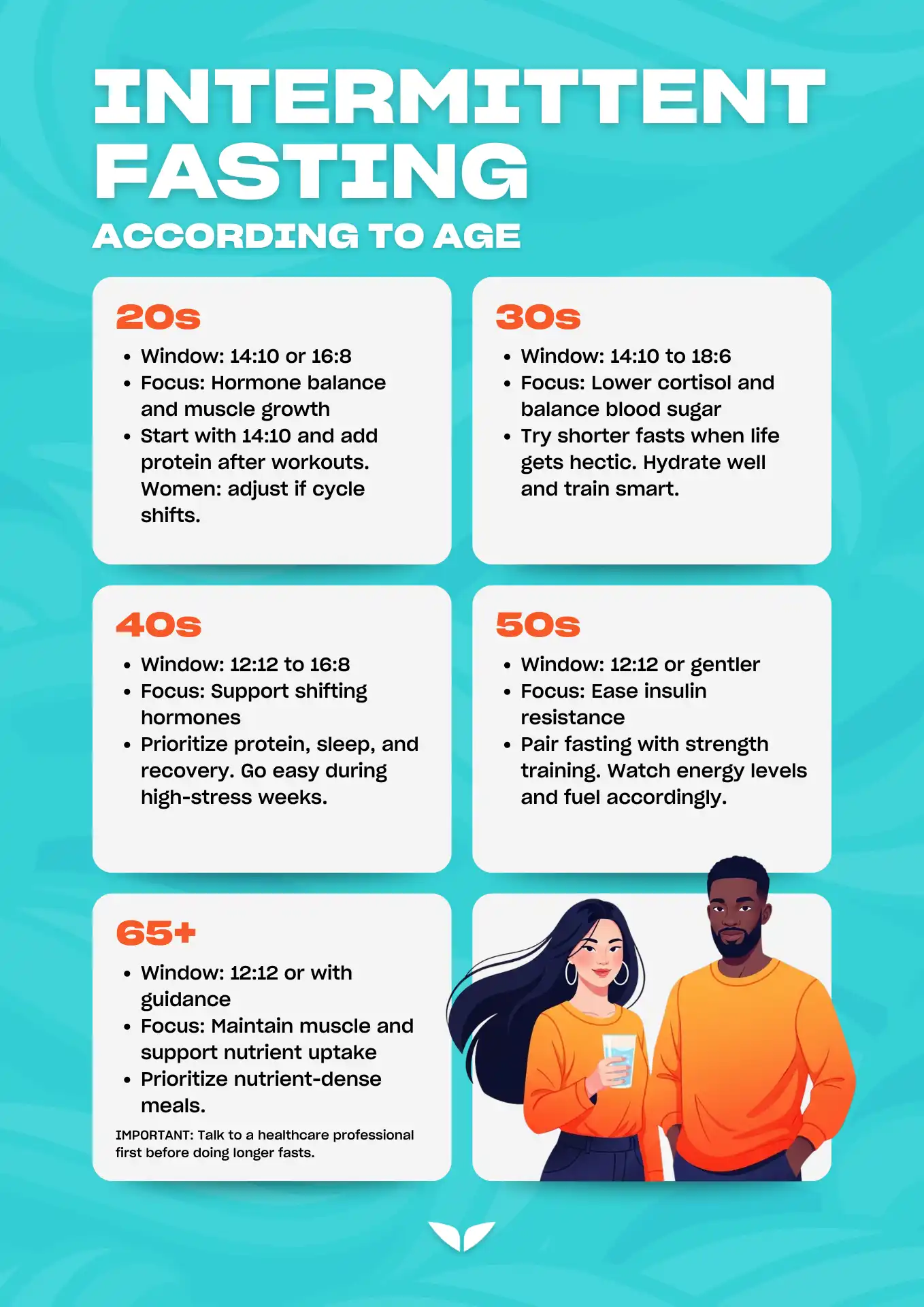
Intermittent fasting for women
Intermittent fasting for women often works better when the timing adjusts to hormonal cycles, not the other way around. Many women do well with 12:12 or 14:10, especially in their 40s and 50s, when perimenopause and menopause change sleep, stress, and blood sugar. Cleveland Clinic advises extra caution during perimenopause, and if your period becomes irregular, that’s a sign to ease off. For cycle-based schedules and more detail, see our guide to intermittent fasting for women.
Intermittent fasting for men
Men can usually stick to a steady daily schedule, such as 16:8, without much hormonal disruption. The bigger risk is losing muscle, especially after 50. Pairing your eating window with enough protein and regular strength training helps you lose fat while keeping lean mass.
Physiology of aging and fasting
Two people can follow the same intermittent fasting schedule and feel completely different. The reason? Biology. What really makes a difference is knowing what your body’s working with (and working against) at every stage of life.
| In your 20s, growth hormone is high, metabolism is fast, and your body rebounds from everything, like revenge bedtime procrastination, skipped meals, and one too many Jägerbombs. Fasting feels easy here, especially if your goal is maintenance or fat loss. But most 20-somethings underconsume protein and overdo caffeine, which makes longer fasts harder to sustain well. |
| In your 30s, cortisol creeps up, stress hits differently, blood sugar isn’t as stable as it used to be, and sleep starts to matter more. Fasting can help regulate all of it, as long as you’re not already burning out from overtraining, undereating, and answering Slack messages at midnight. |
| In your 40s, hormones start throwing curveballs. Estrogen and progesterone begin their slow exit, testosterone drops, and the thyroid might start dragging. Therefore, recovery takes longer. That’s why most versions of the intermittent fasting by age chart for women recommend a gentler rhythm, paired with bodyweight exercises, more protein, and more sleep than you’re probably getting. |
| In your 50s and beyond, muscle loss (sarcopenia) speeds up, bone density may decline, and appetite might shrink even when your body needs more nutrients. This is not the time for aggressive fasting. Instead, focus on shorter fasting windows, stay hydrated, and make protein your non-negotiable. Lena also recommends pairing adequate protein with resistance training to support muscle repair and sticking to balanced, whole-food meals to keep your metabolism steady without slipping into underfueling. |
Fasting do’s and don’ts by life stage
Your fasting window isn’t the only thing that needs adjusting as you age. What you eat, how you move, and how you recover matter just as much.
Don’t make the fasting complicated. Fasting is supposed to make your life easier and not harder.
Ronan Diego, trainer of Mindvalley’s Beyond Fasting program
So, before you commit to skipping breakfast forever, read this first.
| Age group | Do’s | Don’ts |
| 20s | Start with 14:10 or 16:8 to build consistency Eat enough protein to support muscle growth Use fasting to support gut health and energy, not crash dieting | Overdo caffeine and call it “biohacking” Skip meals to save calories for drinking alcohol Fast through intense workouts without proper refueling |
| 30s | Use fasting to balance blood sugar and stress Opt for quality sleep over squeezing in fasted workouts Cycle your fasting windows based on stress levels | Push 18:6 or OMAD when you’re already running on empty Ignore signs of burnout like fatigue or feeling overwhelmed Treat every weekday like a willpower test |
| 40s | Pair fasting with resistance training and more protein Listen to your thyroid and mood before tightening your window Use fasting to create routine, not restriction | Assume what worked at 25 will still work now Fast through perimenopause symptoms without support Chase weight loss at the cost of sleep and sanity |
| 50s and beyond | Keep windows shorter (12:12 to 14:10 works well) Focus on nutrient density and daily hydration Talk to a practitioner if you’re on meds or managing chronic conditions | Let fasting replace meals; undereating is not the goal Skip strength training (muscle is medicine now) Expect aggressive fasting to feel good or even safe |
As you age, you’re at greater risk of missing key nutrients, especially while fasting. “Nutrient requirements alter with aging, and there is a likelihood for nutrient deficiencies of vitamin B12, calcium, vitamin D, and iron,” Lena says. So load your plate with lean protein, vegetables, whole grains, healthy fats, and plant-based options, and get labs done if you suspect a gap.
Eat the way you evolved
Join Eric Edmeades’s free masterclass on food freedom and ancestral eating.

What are the benefits of intermittent fasting?
The main intermittent fasting benefits are weight loss, better insulin sensitivity, and improvements in blood pressure and other markers of metabolic health. Many of these effects come from eating fewer calories, but some appear to come from the fasting itself. Evidence for longer-term benefits like longevity and brain health is promising but still comes mostly from animal studies.
Here’s what the research supports so far:
- Weight and fat loss. A 2020 systematic review of 27 trials found weight loss of 0.8% to 13% of starting weight, and a 2024 meta-analysis confirmed meaningful weight loss with time-restricted eating.
- Insulin sensitivity. The NEJM review describes trials where 5:2 fasting improved insulin sensitivity more than daily calorie cutting, with the same weight loss, and newer trials point the same way.
- Blood pressure and heart rate. The same review reports improvements in blood pressure and resting heart rate, often within 2 to 4 weeks.
- Inflammation. Mayo Clinic notes some research suggests fasting may reduce inflammation more than other diets, though this is still preliminary, and a 2024 review on fasting and inflammation reaches a similar cautious conclusion.
- Overall metabolic health. An umbrella review of 153 studies found fasting improved several metabolic markers compared with standard diets.
- Hormonal balance. Fasting can support healthier hormone patterns, though results differ between men and women and by life stage.
- Brain health and longevity. Animal studies show better memory and longer lifespan, but human data is limited.
Does intermittent fasting work for weight loss?
Yes, intermittent fasting for weight loss works, but mostly because it helps you eat less. In the Welton review, twelve studies that compared fasting with standard calorie restriction found equivalent results. So it isn’t magic, but many people find a clear eating window easier to follow than counting calories.
How much weight can you lose in a month? It depends on your starting weight, what you eat in your eating window, and how active you are. Most trials run from a few weeks to six months, and results range widely. Expect steady progress rather than dramatic drops, and judge results over two to three months, not two weeks.
If belly fat is your goal, no fasting window targets it directly. Fat loss happens across the whole body, so the best window for losing belly fat is the one that helps you stay in a calorie deficit while protecting sleep and muscle. Our holistic weight loss guide covers the other habits that matter.
What’s your body type?
Take this quick quiz to discover your body type.

Is intermittent fasting healthy? Risks and who should avoid it
Intermittent fasting is safe for many healthy adults, but it isn’t right for everyone. Common side effects include hunger, fatigue, headaches, irritability, nausea, and trouble sleeping, which usually ease within a month as your body adapts. People with certain health conditions should avoid it or only try it with a doctor’s guidance.
According to Johns Hopkins and Mayo Clinic, you should skip intermittent fasting or talk to your doctor first if you:
- are under 18
- are pregnant or breastfeeding
- have type 1 diabetes and take insulin, or have type 2 diabetes
- have a history of eating disorders
- have kidney stones, gastroesophageal reflux, or another chronic condition
- take medications that need to be taken with food
It’s also worth knowing about one headline-grabbing finding. A preliminary 2024 American Heart Association abstract of about 20,000 US adults linked eating within an 8-hour window to a 91% higher risk of cardiovascular death. The study was observational, relied on two days of food recall, and wasn’t peer-reviewed when presented, so it can’t show cause and effect. Still, it’s a reminder that long-term human data is limited.
How does intermittent fasting affect metabolism?
Fasting trains your metabolism to switch between fuel sources. Instead of burning quick sugars all day, your body taps into fat stores and produces more ketones, which can mean steadier energy and fewer hangry moments. That ability to switch fuels, called metabolic flexibility, is one of the main reasons researchers are interested in fasting.
Intermittent fasting rules: how to start
The basic rules of intermittent fasting are simple: pick a fasting window, stick to it most days, drink calorie-free fluids while fasting, and eat nourishing meals when your window opens. You’ve seen the intermittent fasting by age chart. Now here’s how to turn it into a routine that fits your life:
- Pick your next milestone. What do you care about achieving in the next month? Weight loss? Stronger immunity? Sharper focus? Choose one goal and write it down.
- Choose your fasting protocol based on how ready you feel. Ronan offers four levels: testing the waters (12 to 16 hours, flexible and forgiving), chill (14 to 16 hours with a few off days), like a boss (16 hours daily with minimal slip-ups), and master (16 hours daily at the same time, no exceptions).
- Define your fasting rules. Decide what’s allowed in your fasting window, such as water, black coffee, or electrolytes, and stick to your list.
- Plan your eating window and keep it consistent. If you always eat between 10 AM and 6 PM, your circadian rhythm, digestion, and sleep get a boost.
- Rewire how you eat. Sit at a table and skip the scrolling. Mindful meals help your brain register what you ate and reduce the urge to overeat later.
- Supplement wisely. Nutritional biochemist Shawn Wells, MPH, LDN, RD, recommends electrolytes to stay hydrated during fasts in his Mindvalley program, The Ultimate Guide to Supplements.
- Adjust as needed. If 16 hours feels like a push, do 14. Stop and talk to a professional if you feel dizzy, unwell, or obsessed with food.
How long does it take for intermittent fasting to work?
Most people need about two to four weeks to adapt to a fasting routine. Hunger and irritability usually fade within that first month, and cardiovascular improvements often show up within 2 to 4 weeks in studies. Visible weight loss typically takes longer, so give any schedule at least 8 to 12 weeks before judging it.
What can you eat and drink while intermittent fasting?
During your fasting window, stick to calorie-free drinks like water, black coffee, and plain tea. Anything with calories, including milk, cream, sugar, and juice, technically breaks your fast. During your eating window, there are no forbidden foods, but Johns Hopkins recommends a Mediterranean-style pattern rich in vegetables, whole grains, lean protein, and healthy fats.
- Allowed while fasting: water, sparkling water, black coffee, plain tea, and electrolytes without sugar
- Breaks a fast: milk, cream, sugar, juice, smoothies, bone broth, and alcohol
- Debated: chewing gum, diet soda, and artificial sweeteners, which some experts say can trigger cravings or an insulin response
- Best foods to break a fast: protein, fiber-rich vegetables, and healthy fats, rather than a large sugary meal
Does coffee break intermittent fasting?
No, black coffee doesn’t break intermittent fasting. It has almost no calories, and one small study found black coffee had no significant effect on blood glucose or triglycerides during metabolic testing. Once you add cream, sugar, or syrup, though, it’s more of a dessert in a mug than a fasting drink.
Some people also add electrolytes during longer fasts. Just make sure your coffee doesn’t turn into breakfast.

Frequently asked questions about intermittent fasting
Futureproof your well-being
IF is a simple eating pattern with real research behind it, as long as you choose a schedule that fits your age, hormones, and lifestyle. Most of us try it, then blame ourselves when it backfires with mood swings, stubborn weight, and burnout, without realizing the plan simply didn’t fit.
If you want guidance, there’s a free Mindvalley masterclass that teaches you how to fast smarter, not harder. Guided by Ronan Diego and Vishen, Mindvalley’s CEO, you’ll learn how to:
- Burn fat without burning out,
- Balance hormones without guesswork,
- Find your personal fasting sweet spot, and
- Boost clarity, energy, and longevity.
More than 66,000 students have used this system to reset their metabolism. Like Alexis Rotenberg, a VP from the U.K., who found a way to fast without stress that fit his travel schedule, demanding job, and social life. He shares on Mindvalley Stories:
Learning to eat well without compromising its pleasures is one of the greatest gifts of life and this Quest gives people this incredible opportunity.
Fasting is about precision, not restriction. Welcome in.