You took an IQ test, got a number back, and now you want to know where it sits. Here’s the short answer: the average IQ is 100, and about two-thirds of Americans score between 85 and 115. Below, you’ll find why 100 is the middle, the US and state averages, how scores work at every age, and what it means to land above or below the line.
What is the average IQ?
The average IQ is 100. IQ tests are built so that 100 sits at the exact middle of the population, with a standard deviation of 15 points, which means about 68% of people score between 85 and 115. So “average” is really a range, not a single number.
Standard deviation is a measure of how far scores typically spread out from the average. On IQ tests, one standard deviation is 15 points, so 85 is one step below the middle and 115 is one step above it.
The number 100 isn’t a coincidence. Test makers use a process called norming: they give the test to a large sample of people chosen to mirror the US population by age, sex, region and education level, then set the middle score to 100. Your score shows where you land compared with that sample.
That’s also why tests get re-normed every 10 to 20 years. If the norms go stale, the average drifts, which is exactly what the Flynn effect is about (more on that below).
What does IQ stand for?
IQ stands for intelligence quotient, from the German “Intelligenzquotient” coined by psychologist William Stern in 1912. Early tests divided a child’s “mental age” by their actual age and multiplied by 100. Modern tests no longer use that formula; instead, they compare your performance with people your own age.
Here’s how the old ratio worked: a 10-year-old who performed like a typical 10-year-old scored 100, while a 10-year-old who performed like a typical 12-year-old scored 120. The ratio broke down for adults (a 40-year-old doesn’t have a “mental age” of 60), so today’s tests use a “deviation IQ” based on the bell curve. As Mensa International puts it, an adult IQ is really “an indication of how well one performs on mental tests compared to others.”
What is considered an average IQ range?
An average IQ range is 90 to 109 on the Wechsler tests, the most widely used IQ tests in the US. You’ll also see 85 to 115 quoted, which is simply one standard deviation either side of 100. Both are correct; they just draw the line in slightly different places.
Here’s how the Wechsler bands sit around the average, with the share of people in each band:
| IQ range | Wechsler label | Approx. % of people |
| 130 and above | Very superior | 2.2% |
| 120-129 | Superior | 6.7% |
| 110-119 | High average | 16.1% |
| 90-109 | Average | 50% |
| 80-89 | Low average | 16.1% |
| 70-79 | Borderline | 6.7% |
| 69 and below | Extremely low | 2.2% |
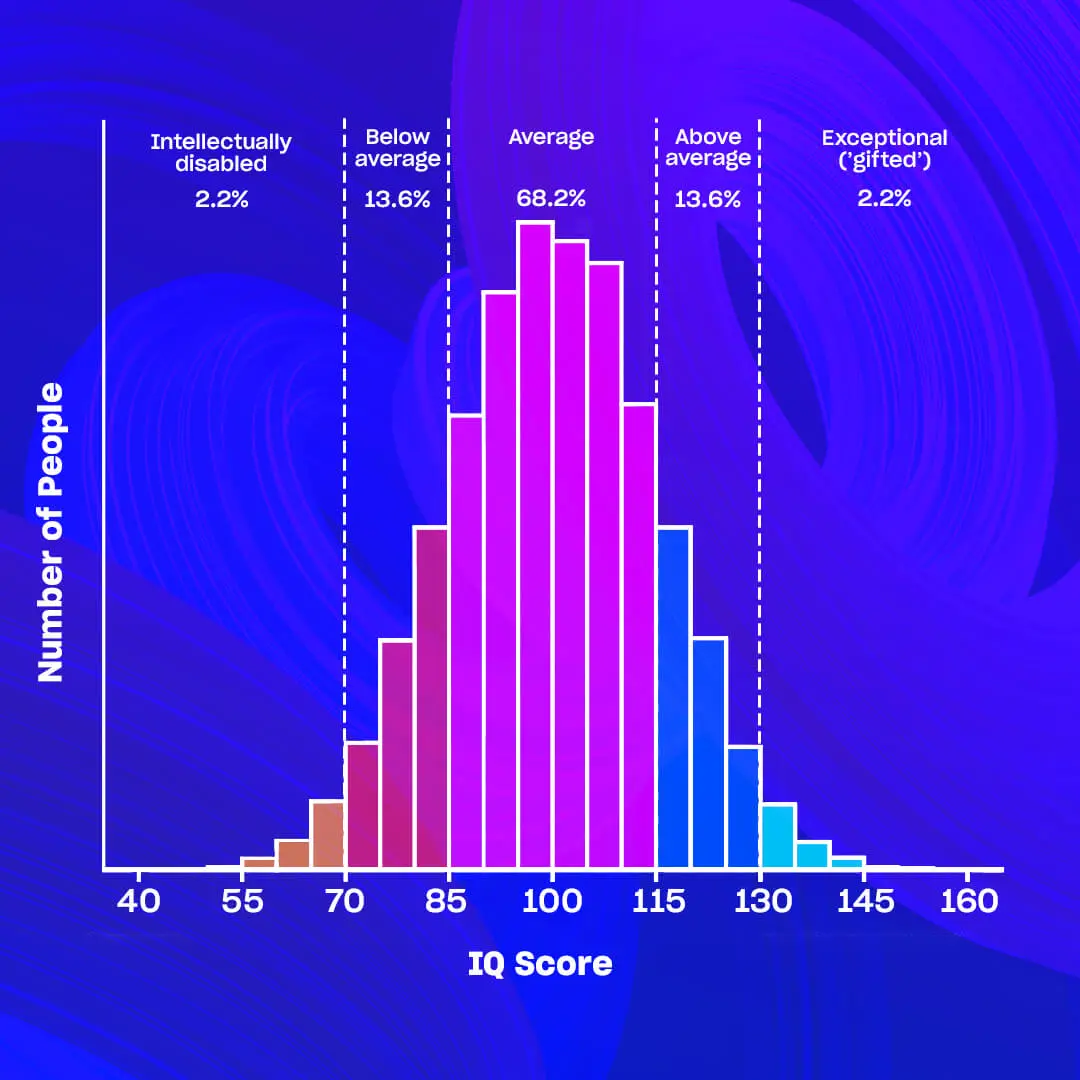
The chart above shows why: IQ scores follow a bell curve, so most people cluster near 100 and fewer and fewer score toward either end. About 95% of people fall between 70 and 130. Every test also has a margin of error of a few points, so a score of 104 is better read as “somewhere around 100 to 108.”

What is the average IQ in the US?
The average IQ in the US is 100 on American-normed tests such as the WAIS-5, because those tests are calibrated on US samples. Cross-population estimates, such as World Population Review’s figure of 97.43, put the average American IQ at around 97 to 98. Either way, the average IQ in the USA sits inside the range where most people score, and 97 to 98 is well within it.
So why two numbers? The 100 comes from how the test is built: the average American in the norming sample scores 100 by definition. The 97 to 98 figure comes from researchers who pool results from many different tests and studies onto a common scale. Those estimates are rougher and depend on which studies get included, so treat them as a ballpark for the average IQ in America, not a precise measurement.
Average IQ by state
The most-cited estimates of average IQ by state come from a 2006 study by psychologist Michael McDaniel, published in the journal Intelligence. Massachusetts had the highest estimated average (104.3) and Mississippi the lowest (94.2). Here are the five highest and five lowest:
| Highest estimated state IQ | Score | Lowest estimated state IQ | Score |
| Massachusetts | 104.3 | Mississippi | 94.2 |
| New Hampshire | 104.2 | Louisiana | 95.3 |
| North Dakota | 103.8 | California | 95.5 |
| Vermont | 103.8 | Hawaii | 95.6 |
| Minnesota | 103.7 | Alabama / New Mexico | 95.7 |
There’s an important catch. These aren’t IQ tests given to each state’s adults. McDaniel converted fourth and eighth-grade reading and math scores from the National Assessment of Educational Progress (NAEP) onto an IQ-style scale. The gaps mostly reflect school performance, income and education, not a fixed difference between people in different states.
Is the average IQ going up or down?
For most of the 20th century, IQ scores in the US rose by about 3 points per decade, a trend known as the Flynn effect. More recently, a 2023 Northwestern University study of 394,378 US adults found that scores in verbal reasoning, matrix reasoning and letter-number series dropped between 2006 and 2018, while spatial reasoning improved.
The Flynn effect is named after New Zealand researcher James Flynn. Better nutrition, more schooling and a more abstract, information-heavy world are the usual explanations for why each generation scored higher on the old norms.
The 2023 study, led by Elizabeth Dworak and published in Intelligence, is often described as a “reverse Flynn effect.” That doesn’t mean Americans are getting less capable overall. Shifts in what schools emphasize, how much effort people put into online tests, and which skills daily life trains may all play a part.
Your IQ isn’t your ceiling
Join Jim Kwik’s free Superbrain masterclass and learn how to sharpen your memory, focus, and learning speed at any age.

What is the average IQ score by age?
The average IQ score is 100 at every age, because each person is compared only with people their own age. What changes as you get older is raw ability: fluid reasoning tends to peak in early adulthood and then slowly decline, while vocabulary and general knowledge keep growing well into later life.
Fluid intelligence is your ability to solve new problems on the spot (our guide to fluid reasoning goes deeper). Crystallized intelligence is the knowledge and skills you’ve built up over time. The distinction comes from psychologists Raymond Cattell and John Horn, and it explains why a 70-year-old can score 100 just like a 25-year-old, even though their strengths look different.
Here’s the average IQ by age, with the test typically used for each group:
| Age group | Average IQ score | Normal range (68% of people) | Test typically used |
| 2.5-7 years | 100 | 85-115 | WPPSI-IV (Wechsler Preschool and Primary Scale of Intelligence) |
| 6-16 years | 100 | 85-115 | WISC-V (Wechsler Intelligence Scale for Children) |
| 16-90 years | 100 | 85-115 | WAIS-5 (Wechsler Adult Intelligence Scale) |
| 2-85+ years | 100 | 85-115 | Stanford-Binet Intelligence Scales, Fifth Edition |
You might see charts online claiming that 16-year-olds average 108 or that adults over 65 average 114. Those figures don’t hold up: properly normed tests set every age group’s average at 100, so a chart with different averages by age is either mixing up raw scores or using a test that wasn’t age-normed.
What is the average IQ for a teenager?
The average IQ for a teenager is 100, whether they’re 12, 13, 14, 15 or 16. Teens are compared only with others their age, using the WISC-V up to 16 and the WAIS-5 from 16 onward.
| Age | Average IQ | Test typically used |
| 12-year-old | 100 | WISC-V |
| 13-year-old | 100 | WISC-V |
| 14-year-old | 100 | WISC-V |
| 15-year-old | 100 | WISC-V |
| 16-year-old | 100 | WISC-V or WAIS-5 |
Teen scores can move several points between tests, partly because of measurement error and partly because the brain is still developing through adolescence. So if your 13-year-old scored 95 one year and 103 the next, that’s normal variation, not a sudden jump in intelligence.
What is the average IQ for an adult?
The average IQ for an adult is 100. Adults are usually tested with the WAIS-5, which covers ages 16 to 90 and compares each person with others in the same age band. For most people, the age-normed score stays fairly stable across adulthood.
Do men and women have the same average IQ?
Yes. The average IQ for men and women is essentially the same on modern tests, and major tests like the Wechsler scales are built so that overall scores don’t favor either sex. Small differences show up on some individual subtests, and some research finds slightly more spread in male scores, but there’s no meaningful gap between the average male IQ and the average female IQ.
Train the mind behind the score
Join Vishen Lakhiani’s free Silva Ultramind masterclass and learn meditation techniques to unlock intuition, creativity, and focus.

What does an above or below average IQ mean?
An above average IQ is a score of 110 or higher, which starts the Wechsler “high average” band and sits at about the 75th percentile. A below average IQ is a score under 90; 85, for example, sits at about the 16th percentile. A few points either side of the average make little practical difference in everyday life.
If you want to know what counts as a strong score, our guide on what a good IQ is covers it in detail. For the extremes, read about the highest IQ possible and the lowest IQ ever.
One correction worth making: a score below 100 does not mean someone is intellectually disabled. An IQ of around 70 or below is one criterion for intellectual disability, and a diagnosis also requires real limits in everyday functioning that begin in childhood. Only a qualified professional can make that call.
How is the average IQ measured?
The average IQ is measured with standardized tests given one-on-one by a licensed psychologist or trained examiner. Your answers are scored against a norm sample of people your age, and the middle of that sample is set to 100. On the WAIS-5, the core Full Scale IQ takes about 45 minutes.
The WAIS-5 groups the skills it tests into five primary areas:
- Verbal Comprehension: how well you understand words, define concepts and explain ideas
- Visual Spatial: how well you analyze shapes, patterns and how objects fit together
- Fluid Reasoning: how well you solve new problems without relying on past knowledge
- Working Memory: how much information you can hold and use in your head at once
- Processing Speed: how quickly and accurately you take in simple information and respond
Your scores across these areas are combined into one overall number, the Full Scale IQ. Because the tasks lean on logic and analysis, IQ tests mostly reward the skills people associate with left-brain characteristics. The result is reported as a score plus a confidence range, for example “104 (100-108).” Our guide on how to test your IQ walks through the options.
Are online IQ tests accurate?
Free online IQ tests can give you a rough, fun estimate, but they aren’t clinically valid. Most aren’t normed on a representative US sample, aren’t supervised and can’t control for guessing or retakes. Only a professionally administered test tells you reliably where you sit.
Why do some people score above or below the average IQ?
Scores above or below 100 come from genes and environment working together. In a 2015 review, behavioral geneticists Robert Plomin and Ian Deary reported that the heritability of intelligence rises from about 20% in infancy to as much as 80% in later adulthood. Environment still shapes how that potential develops.
On the environmental side, the biggest known influences include:
- Education: a 2018 meta-analysis by Stuart Ritchie and Elliot Tucker-Drob found each extra year of school adds about 1 to 5 IQ points
- Early nutrition: iodine and iron deficiencies in childhood are linked to lower scores
- Sleep and stress: poor sleep and long-term stress affect memory and focus on test day and beyond
- Early environment: language-rich homes, stability and access to books
Read faster, remember more
Discover Jim Kwik’s free Superreading masterclass and learn techniques to get through books faster and retain what you read.

The average IQ isn’t the whole picture
An IQ score is a narrow measure of specific thinking skills. It doesn’t capture creativity, emotional intelligence or the different types of learning styles people bring to a problem. Howard Gardner’s theory of multiple intelligences argues there are several kinds of intelligence that standard tests miss.
Research also suggests we may have up to nine different types of intelligence, and you can develop each of them. Curious which one is your strongest? Take the free quiz below.
Frequently asked questions about average IQ
What your IQ score really tells you
The average IQ in the US is 100, and most Americans score between 85 and 115. An IQ score is a useful snapshot of certain thinking skills at one point in time, not a measure of your worth or your potential. If you’d like to train your focus, memory and learning speed, Jim Kwik’s Superbrain Quest on Mindvalley is a practical place to start.