I woke up this morning feeling something I haven’t felt about American politics in a long time.
Relief.
And what an election.
This wasn’t just a blue tsunami. It was a blue nuclear bomb.
Democrats have taken back both houses of Congress, winning races in places that have been Republican strongholds for generations.
And watching from Malaysia, I’m relieved.
America’s decisions don’t just affect Americans. They affect the rest of the world. The wars America fights, the economic decisions it makes, the relationships it builds or breaks.
But something else fascinated me about this election.
The extraordinary power of storytelling.
Because while there were many reasons for the results, including frustration over the economy, the war with Iran, and government accountability, some of the most interesting political figures to watch were people who knew how to turn complicated ideas into stories.
Let me give you four examples.
Four politicians. Four lessons in storytelling.
1. James Talarico: Make the problem human.
In Texas, Talarico spoke about an airport worker named Augusta.
She spent ten-hour shifts cleaning airplanes without air conditioning, working hard but still struggling to afford everyday necessities.
Now, Talarico could have talked about wage stagnation, inflation, or economic inequality.
Instead, he told the story of one woman.
And suddenly, the economy wasn’t a spreadsheet.
It was a human being.
That’s what great storytelling does. It takes an abstract problem and makes you understand what it feels like.
2. Zohran Mamdani: Paint a scene people recognize.
Listen to how New York City’s mayor talks about affordability.
Rather than simply discussing housing costs or transportation budgets, he describes the lives of ordinary New Yorkers.
Cramped kitchens. Taxi drivers waiting at LaGuardia. Workers coming home after long shifts, their knees aching.
You can picture these people.
You can imagine their lives.
And suddenly, complicated public policies become stories about everyday experiences.
3. Abdul El-Sayed: Make your message unforgettable.
In Michigan, El-Sayed built his campaign around a simple economic idea.
Get money out of politics. Put money back into people’s pockets.
Notice how memorable that is.
Two short sentences.
One problem. One proposed direction.
You don’t need a political science degree to understand the message.
And that is a powerful communication skill.
4. Jon Ossoff: Make people see what’s at stake.
Ossoff, the senator from Georgia, gave a remarkable victory speech last night.
He spoke about families struggling with healthcare costs and the responsibilities of government.
But then he made it personal.
He talked about his two young daughters, Eva and Lila.
And about the kind of world he wants them to inherit.
He imagined his daughter one day asking what he had done about the problems facing their generation.
Suddenly, the subject wasn’t just legislation, political institutions, or the next election.
It was a father thinking about the world his children would grow up in.
That’s the difference between simply communicating a policy and telling a story that makes the stakes feel real.
Now, I’m not suggesting that storytelling alone determined these elections. People voted for many reasons.
And I’m not asking you to agree with any of these politicians.
I’m asking you to study how they communicate.
Because here’s what fascinates me.
You can have the best ideas in the world. But if you cannot communicate them in a way people understand and feel, those ideas may never reach the people who need them.
And the reverse is also true.
Someone with a compelling story can attract enormous attention even when their claims aren’t supported by evidence.
That is both the beauty and the danger of storytelling.
Which is why I believe scientists, teachers, coaches, founders, and anyone with something meaningful to share need to learn this skill.
Holy Shit, That’s So Smart!
Recently, I sat down with Jun Yuh, one of the sharpest young creators I’ve met.
Jun has built an audience of more than 750,000 people on YouTube by helping people turn their knowledge and experiences into content and businesses.
And we had one of the most fascinating conversations I’ve had about storytelling, personal branding, and the psychology of influence.
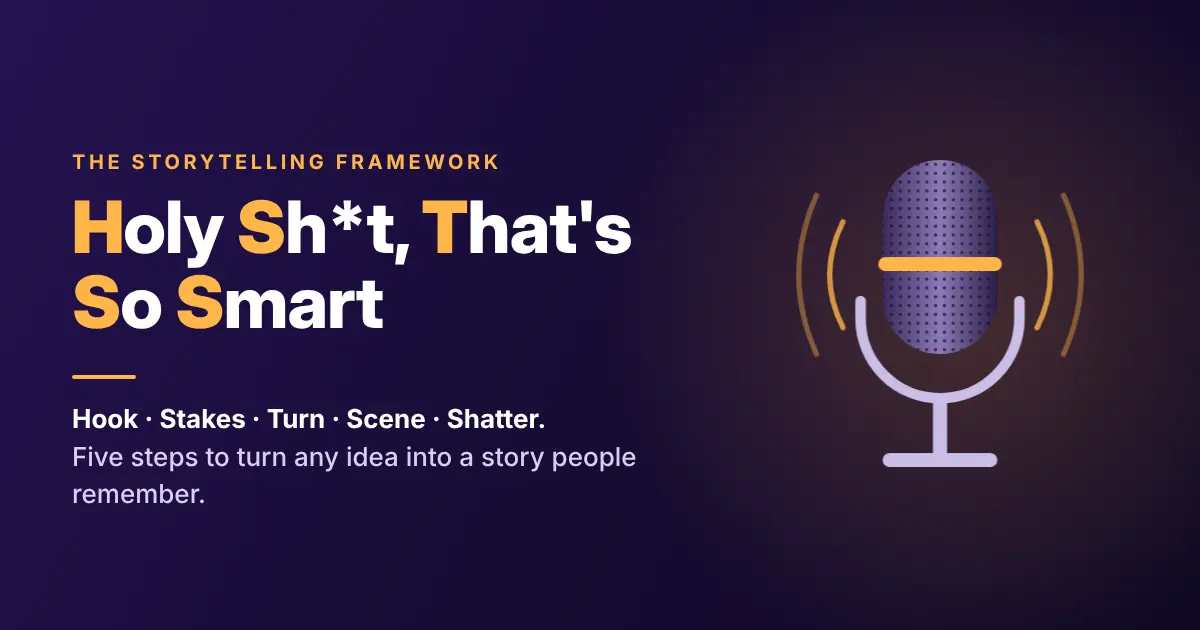
I shared the five-part storytelling framework I use to turn ideas into stories people remember.
It’s called:
HOLY SHIT, THAT’S SO SMART!
Yes, that’s actually the name. 😂
I deliberately made it a little outrageous.
Because you’re probably not going to forget it.
Here’s how it works.
H — Hook: The opening sentence that stops someone scrolling.
S — Stakes: Why your audience should care. The problem, the struggle, the emotional cost.
T — Turn: The discovery or insight that changes everything.
S — Scene: The vivid details that make people feel as though they’re actually there.
S — Shatter: The final insight that breaks an old belief and gives someone a new way of seeing the world.
Five steps.
And once you understand them, you’ll start noticing this structure everywhere.
In political speeches.
In viral videos.
In great advertising.
And in the stories that shape our lives.
But knowing the five steps is only the beginning.
In my conversation with Jun, I demonstrated exactly how to use them.
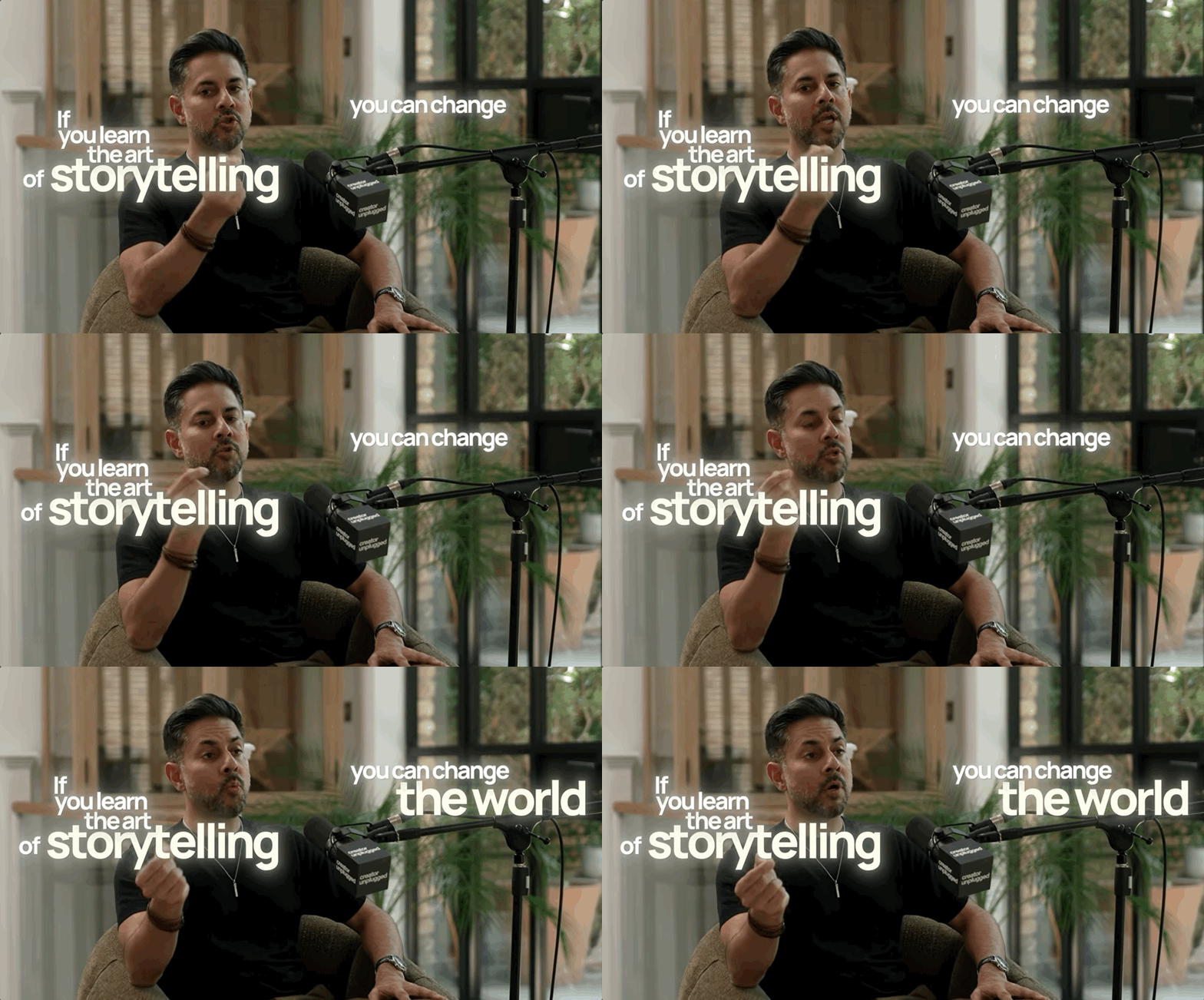
Watch The Full Conversation With Jun Yuh
Here’s what you’ll learn:
- The first 11 seconds: Why the first three seconds stop the scroll, and what the next eight seconds need to accomplish.
- Holy Shit, That’s So Smart! in action: How to use all five steps to turn an ordinary idea into a story people remember.
- The 150,000-view lesson: How moving one sentence from the end of a video to the beginning helped it reach 150,000 views in 48 hours.
- The Living Citation: How to share someone else’s brilliant idea through your own experience, while giving them credit.
- Why confident people often outperform experts online: And how people with genuine knowledge can become better communicators without abandoning accuracy.
- The unexpected interview reversal: What happened when I stopped answering Jun’s questions and started asking him about the experiences that shaped his life.
That last part is particularly special.
Halfway through the conversation, I turn the tables on Jun.
I ask him about his childhood, his family, and why he became an entrepreneur.
And we uncover something deeply moving.
The real reason he does his work.
It’s a beautiful example of how the stories that connect most deeply with people often come from experiences we don’t initially think are worth sharing.
One final thought
I’ve spent more than two decades building Mindvalley.
And one of the biggest lessons I’ve learned is this:
Having a great idea is only half the battle.
The other half is helping people understand why that idea matters.
You don’t need a massive audience.
You don’t need a production studio.
You don’t need perfect lighting, a perfect voice, or a million-dollar marketing budget.
You need something meaningful to say.
And you need to know how to tell its story.
Because one story can change someone’s mind.
One story can transform a business.
One story can inspire a movement.
And sometimes, one story can change the world.
Watch The Interview And Learn My Storytelling Framework
With love,
P.S. A special early-access Black Friday offer for our community. 🖤 Before we open this to the world, I wanted you to have it first. Until Black Friday, you can get 40% off Mindvalley Membership, our best offer of the year. Get Your Early Black Friday Offer.